Turmeric is in almost every Indian dish, is bought in powder form by almost everybody, and is among the most adulterated spices on the market. Those three facts together are worth ten minutes of attention.
Short answer: Buy whole turmeric fingers and grind them. Powder is where adulteration happens - most of it harmless starch, but lead chromate, used to brighten colour, is not, and no home test reliably catches it.

The two home tests
For starch and chalk. Stir half a teaspoon of haldi into a glass of warm water and leave it. Pure turmeric settles slowly into a light yellow sediment with a clear-ish yellow liquid above. Heavy white sediment at the bottom, or a chalky layer, suggests bulking. This test is crude but it catches the obvious cases.
For metanil yellow. Add a few drops of hydrochloric acid, or lemon juice at a pinch, to a little haldi mixed in water. Pure turmeric stays yellow or turns slightly reddish-brown. A bright pink or magenta colour that persists suggests metanil yellow, a banned industrial dye.
Both of these are worth doing once with a new source. Neither is reliable enough to be a guarantee.
The one you cannot test for at home
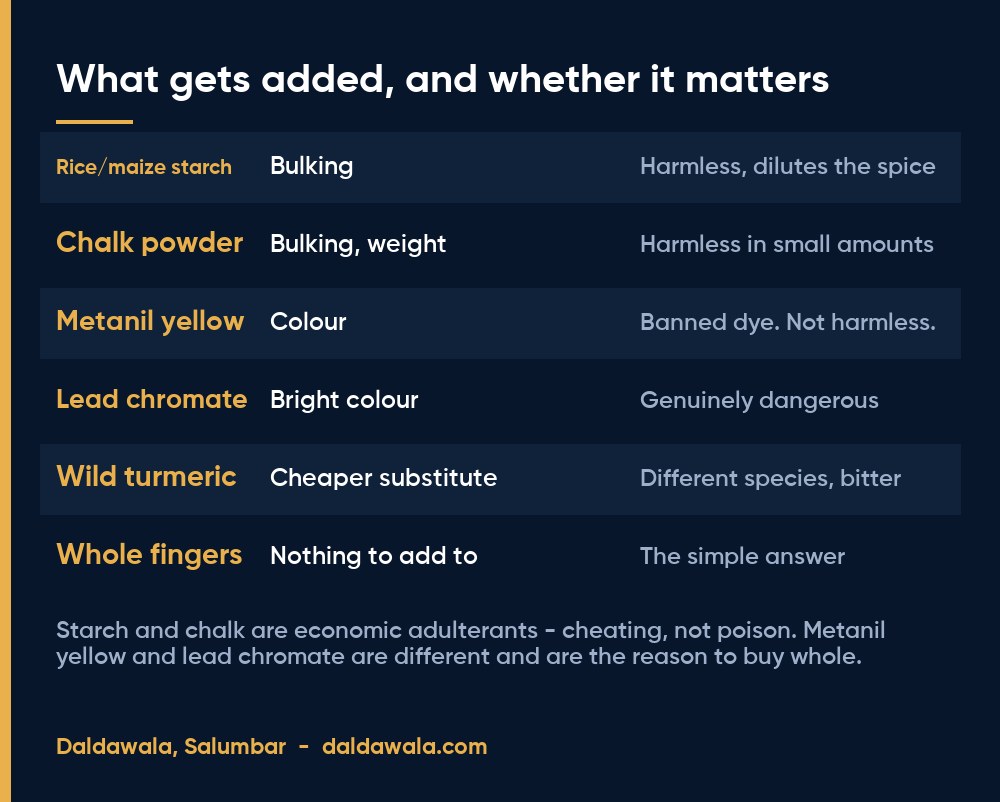
Lead chromate is added to turmeric to make it a brighter, more saleable yellow. It has been documented in Indian and Bangladeshi turmeric supply chains in published research, and it is the reason this is a safety topic and not just a value-for-money one.
Lead is a cumulative neurotoxin, particularly harmful to children, and there is no safe level. There is also no home test for it - no water test, no acid test, nothing you can do in a kitchen.
What you can do is remove the opportunity. Lead chromate is added to powder, because it needs to be mixed in. A whole turmeric finger cannot be adulterated this way. Buying whole and grinding at home is not a precaution against a theoretical risk; it is the only practical defence against this specific one.
Buying whole fingers
Whole turmeric comes as hard, dry fingers, somewhere between an orange-brown and a deep ochre on the outside. Snap one: the inside should be a strong even orange-yellow, and it should snap rather than bend.
They are genuinely hard - harder than people expect - and a domestic mixie will struggle. The usual approach is to break them into small pieces first with a hammer or a pestle, then grind in short bursts, or to take a batch to a chakki, which most towns including Salumbar still have.
Grind two to three months' worth at a time. Turmeric powder holds its colour longer than its aroma, which is what makes stale haldi hard to notice - it still looks fine.
Whole fingers keep two years and more in an airtight jar away from light.
The black pepper thing, which is real
Curcumin, the compound most of the turmeric health claims are about, is poorly absorbed on its own. Piperine, from black pepper, inhibits the liver enzyme that clears it, and the frequently cited study found absorption increased very substantially when the two were taken together.
Which is a satisfying piece of traditional cooking turning out to have a mechanism - haldi and kali mirch have gone into the same pot for a very long time.
Worth keeping in proportion, though. The curcumin content of culinary turmeric is modest, the amounts in a dish are small, and "better absorbed" is not the same as "a meaningful dose". A pinch of pepper with the haldi is a good habit and not a treatment.
Buying it in Salumbar
Our spices is on this site with the weight and the price on every pack. Order before 5 PM and it reaches you the same day inside Salumbar, free over ₹200. We have been on Sadar Bazar since 1961. If you would rather just say what you want, send it on WhatsApp and we will confirm the price before we pack anything.
Questions people ask
How do I check if turmeric is adulterated?
Stir it into warm water - pure turmeric settles slowly with no chalky white layer. For banned dye, a few drops of acid turning it bright pink is a warning sign. Neither test catches lead chromate.
Is lead in turmeric a real problem?
It has been documented in published research on Indian and Bangladeshi supply chains. Lead chromate is added to powder to brighten colour. There is no home test; buying whole fingers removes the opportunity.
Should I buy turmeric whole or powdered?
Whole, if you can grind it or get it ground. It is the only practical defence against colour adulteration, and the powder keeps its aroma only two to three months anyway.
Does black pepper help turmeric work?
Piperine substantially improves curcumin absorption, which is a real and well-documented effect. It still does not turn a pinch of haldi into a therapeutic dose.
How long does haldi powder keep?
Two to three months at full strength. It holds colour much longer than aroma, which is why stale haldi is hard to spot.
What is the difference between haldi and wild turmeric?
Wild turmeric - amba haldi or kasturi manjal - is a different species, more bitter, traditionally used on skin rather than in food. It is sometimes used to bulk out cooking turmeric.



 (1).jpg)