Almost everyone buying cashews for the first time assumes W180 is the best grade and W320 is the cheap one. It is a reasonable guess and it is wrong - which is how people end up paying gift-box prices for cashews they are about to grind into a barfi.
Short answer: The W number is how many whole cashews make up one pound. W180 means 180 big nuts; W320 means 320 smaller ones. It is a size, not a quality - and for anything ground, the broken pieces are the same nut at a third of the price.
Where the number comes from
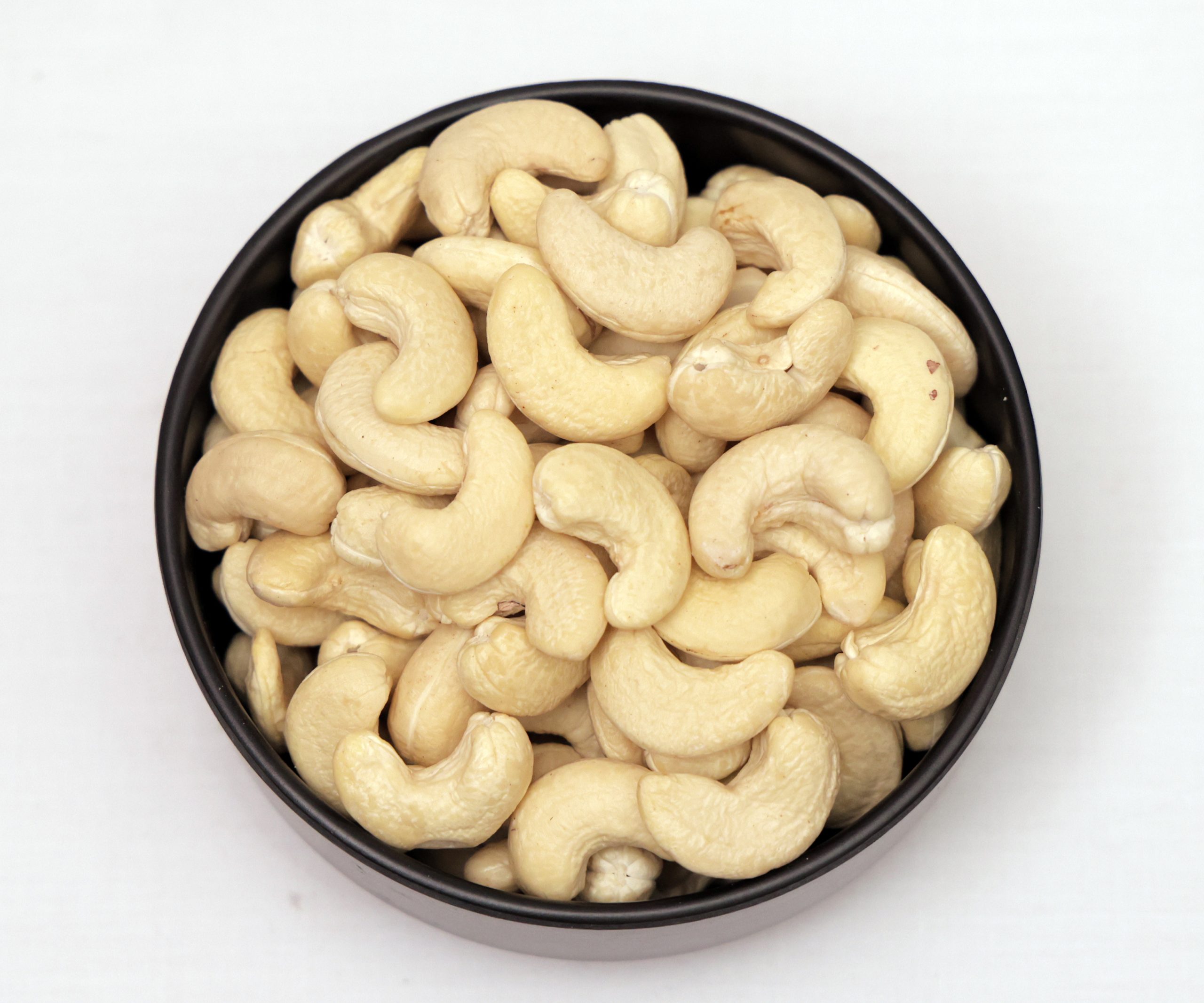
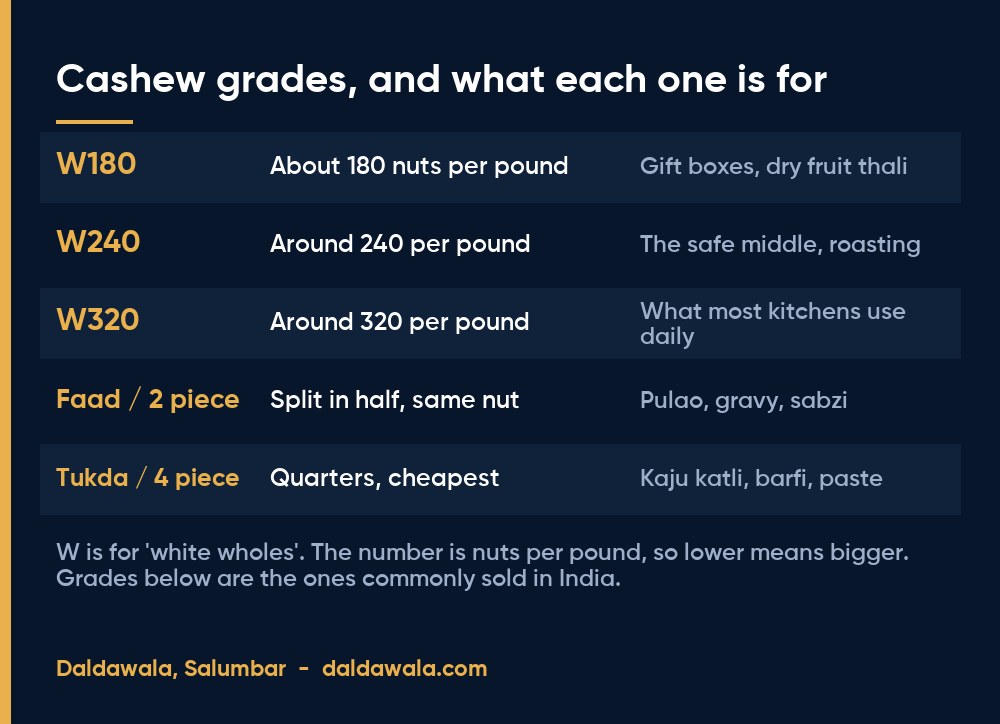
Cashew grading is a sizing system, not a quality one. Nuts are passed over screens and sorted by how many of them it takes to fill a pound - so W180 means roughly 180 whole nuts per pound, and W320 means roughly 320. A lower number is a bigger nut.
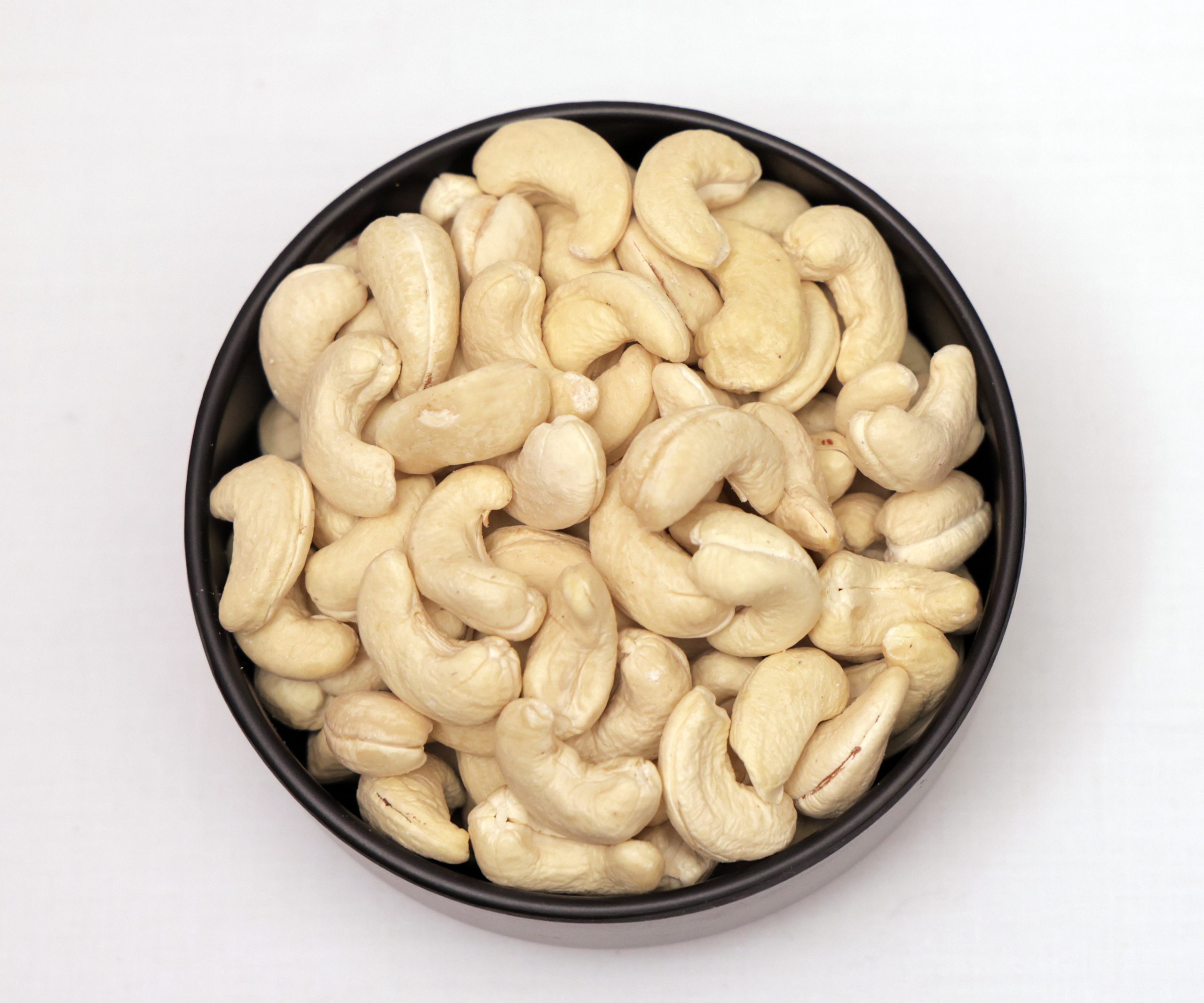
The W stands for white wholes: whole, undamaged, pale cream kernels. There are grades below W for scorched or dessert-quality kernels, but a shop selling to home kitchens is almost always selling W grades and broken pieces.
Why W320 is not a worse cashew
Two nuts from the same tree, the same harvest and the same lot can land in different grades purely because one grew bigger. Nothing about the taste, the freshness or the oil content differs.
What a W180 buys you is appearance. On a gift thali, in a dry fruit box, laid out at a wedding - the size is the point, and it is a reasonable thing to pay for. In a dal, in a pulao, in a kheer, nobody has ever been able to tell.
Which means the honest advice is: buy the grade that matches where the nut will be seen, not the grade that sounds most expensive.
The broken pieces are the real value
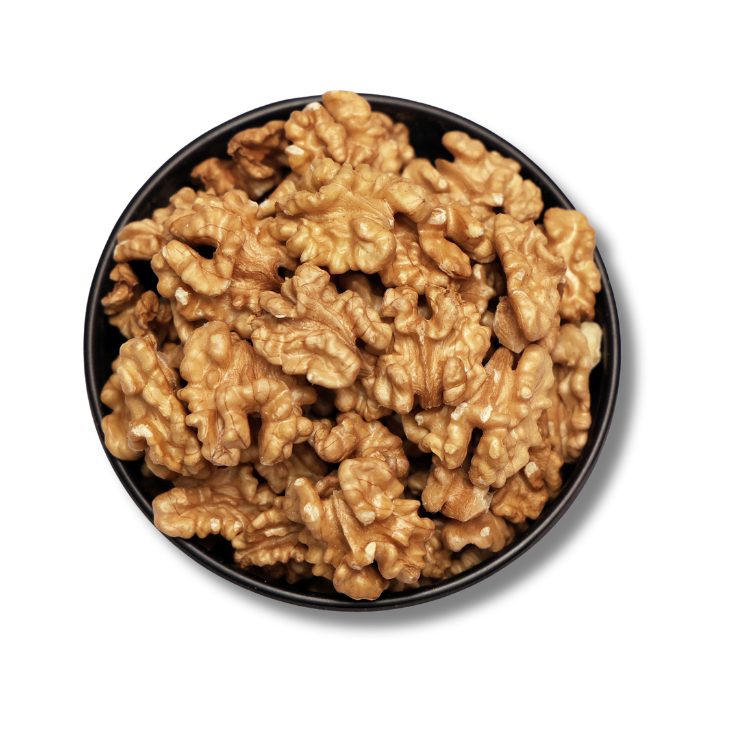
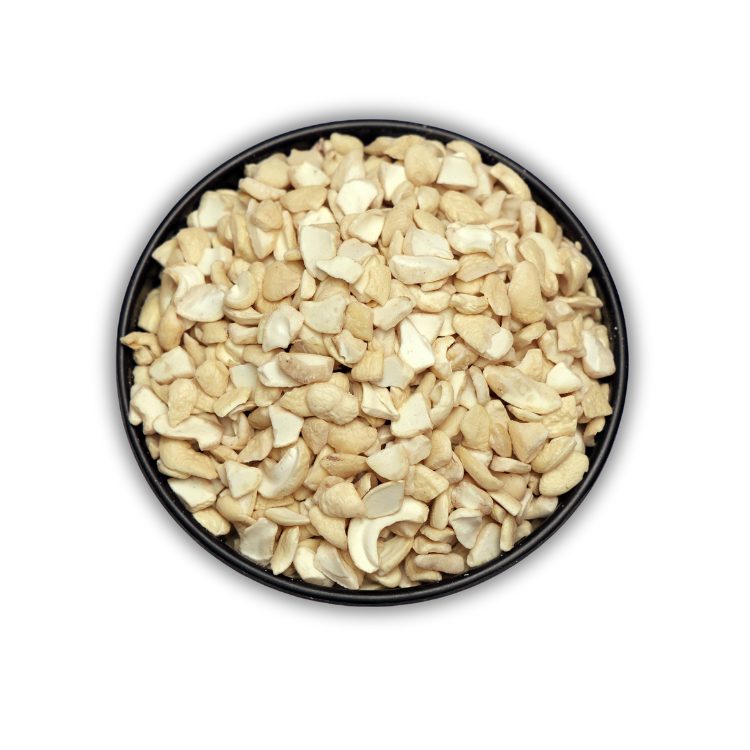
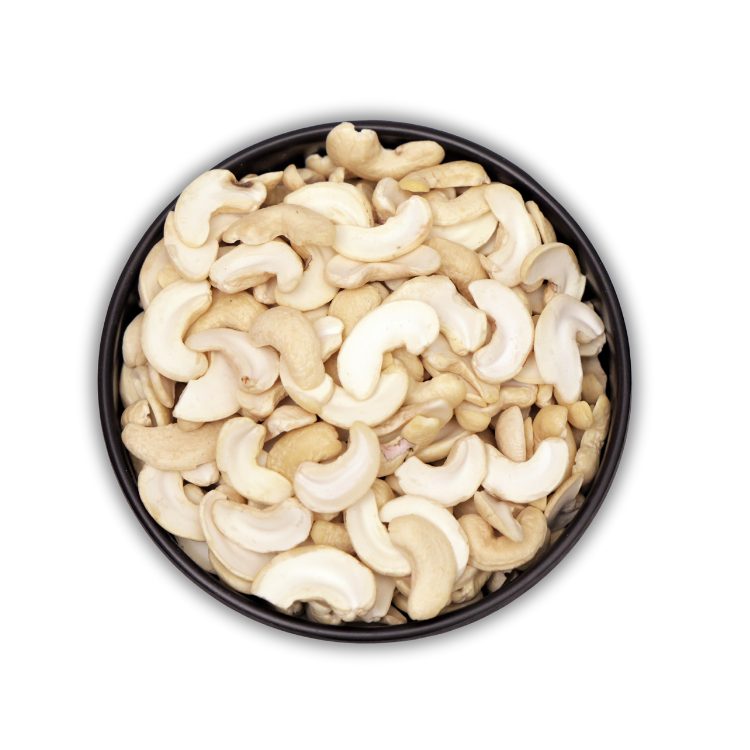
Faad (split in two) and tukda (broken into four) are whole cashews that cracked during shelling or grading. They are the same nut, from the same lot, and they cost noticeably less because they look untidy.
For anything that gets ground, chopped or cooked soft, they are not a compromise - they are the correct purchase. A kilo of tukda will make exactly the same kaju katli as a kilo of W180 and leave a meaningful amount of money in your pocket.
The only thing to watch is that broken pieces have more cut surface exposed to air, so they go stale a little faster. Buy what you will use in a couple of months rather than a yearly stock.
What to check regardless of grade
Grade tells you size. It tells you nothing about age, and age is what actually ruins cashews.
Look for an even cream colour with no grey or yellow patches, a plump shape rather than a shrivelled one, and a clean snap when you break one. Smell a handful: good cashew smells faintly sweet and barely of anything, and old cashew smells like paint. A W180 that smells like paint is worse than a tukda that does not.
Buying it in Salumbar
Our cashew (kaju) is on this site with the weight and the price on every pack. Order before 5 PM and it reaches you the same day inside Salumbar, free over ₹200. We have been on Sadar Bazar since 1961. If you would rather just say what you want, send it on WhatsApp and we will confirm the price before we pack anything.
Questions people ask
Is W180 better quality than W320?
No. Both are whole white kernels; W180 is simply a larger nut. Freshness, colour and smell decide quality, and those are independent of the grade.
What is the cheapest cashew grade?
Four-piece tukda, usually a third to a half less than whole grades. For anything ground or cooked, it is the same product.
What does W stand for?
White wholes - whole, undamaged, pale kernels. Grades outside W cover scorched or dessert-grade kernels, which are rarely sold in home-kitchen quantities.
Which kaju is best for kaju katli?
Tukda. It is going to be ground to a paste, so size is irrelevant and you save a third.
Which kaju for a gift box?
W180 or W240. This is the one job where size genuinely is the point.
Do grades affect nutrition?
Not at all. Same nut, same lot, different screen size.


 (1).jpg)